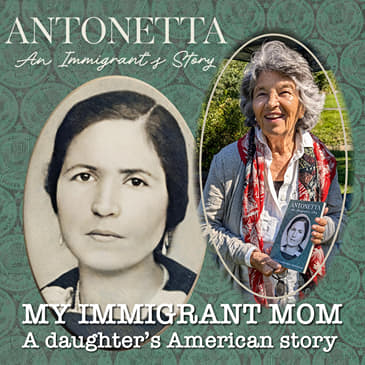


Teresa Magistro shares the remarkable immigrant story of her mother, Antonetta Vincatorio Lombardi—a woman who crossed from poverty in Italy to build a life and raise a family in America. Their conversation explores Italian American history, family traditions, and the stories that can disappear if no one writes them down.
At 81, Teresa published her first book, Antonetta: An Immigrant's Story, after years of telling her mother’s stories to her grandchildren. She reflects on the experiences that shaped Antonetta’s values: arriving in the United States without knowing English, discovering everyday comforts like running water, and insisting that her children value education, hard work, and independence.
The episode also reveals Antonetta’s unexpected six-second moment of fame in a 1964 Rheingold beer commercial, her evolving views on women’s roles, and her open, faith-centered approach to death and remembrance.
Key Topics
[00:01:17] - Teresa’s path from teaching to writing her first book
[00:09:11] - Why family stories need to be written down
[00:15:16] - Antonetta’s childhood in Italy and journey to America
[00:18:03] - Starting over without English—and appreciating life’s everyday comforts
[00:23:40] - Immigration, education, hard work, and family values
[00:27:00] - Antonetta’s changing views on women’s independence
[00:29:21] - The story behind Antonetta’s Rheingold beer commercial appearance
[00:37:04] - Family, faith, and Antonetta’s perspective on death
[00:44:00] - Where to find Teresa’s book and what she may write next
Relevant Links
Teresa’s conversation is a warm reminder that immigrant stories are also family histories—and that preserving them can help future generations understand the sacrifices, hopes, and values that shaped their lives. Antonetta’s story offers a personal glimpse into the contributions of Italian immigrants and the many ways a family’s legacy lives on.
[00:00:03] - [Speaker 0]
Welcome to Typtoon Tint. I'm Tom Kranz. From the villages of old Italy to a moment of fame in an American beer commercial, Antonetta Vincatorio Lombardi lived two lives. First as a young girl in an impoverished Italian town left with no family after her parents died, and then as an American mother and housewife whose old school values formed the building blocks of a strong family. Her immigrant story and all of its facets is the subject of today's episode featuring Antonetta's daughter, Teresa Magistro, who at age 81 wrote her first book with her mom as the star.
[00:00:44] - [Speaker 0: Tom Kranz]
And I'm joined by Teresa Magistro from her palatial estate in New Providence, New Jersey. I'm always happy to interview another New Jersey person. Teresa, how are doing today?
[00:00:55] - [Speaker 1: Theresa Magistro]
Oh, very well. Very well.
[00:00:57] - [Speaker 0]
Great. We are on the tail end of what's left of hurricane Isaias. So it poured rain all day yesterday, and now it's Monday, and we got, it's it's clearing up slowly but surely. But every time I do one of these, it's always either pouring rain, freezing cold, or 95 degrees. So, anyway, welcome to New Jersey, and and thanks for being on the podcast.
[00:01:17] - [Speaker 0]
I met Teresa at the, New Providence Book Festival, which is a small book fair that happens every year in this little town in Union County, New Jersey, New Providence. And she had an adjacent tent to mine, And she was selling her new book, which is one of the reasons we're here today. It's called Antoinette, an immigrant story. Antoinette was her mother, and this is a... And and she informed me that, well, I'm 81 years old, but this is my first book.
[00:01:48] - [Speaker 0]
And I said, really? So that, of course, intrigued me because people who find talent in their creativity later in life is one of the themes of my podcast here. So, Teresa, first of all, tell us... Before we get into all that, tell us a little about your background, where you came from, and what you did for a living or still do even.
[00:02:05] - [Speaker 1]
Okay. Well, I am the daughter of, two immigrant parents and from The Bronx, from New York. And I grew up there and went to public schools and then to City College. And it's interesting, this story. My mother came to America in 1929, in May 1929.
[00:02:33] - [Speaker 1]
And in October, we know it happened, the Depression hit. And my mother's lesson from the Depression was that postal employees were working and teachers were working. So she decided her children had to be teachers because they would have a job in the next Depression and they would have healthcare and benefits. So we all became teachers.
[00:02:59] - [Speaker 0]
No
[00:02:59] - [Speaker 1]
kidding. So I was fortunate to get my undergraduate and master's degree from City College and became a teacher. And first started teaching in New York City and then in Massachusetts and then the longest time in Stamford, Connecticut. My husband Charles is a retired minister, a Unitarian minister and that's how we moved around. And I really spent the most time in Stamford, which was a wonderful, wonderful little city.
[00:03:37] - [Speaker 1]
I've taught there and at one point became president of the Teachers Association, which was great because teachers were getting these horrible contracts and I got angry enough to say, Okay, well, I have to stop complaining. And in Stanford, many people have a wonderful sense of community that they volunteer their time for different community organizations. My husband was on the board of education. And then I became a member of the Urban Redevelopment Commission because I have this strong interest in architecture and the city and the way people move around in cities. I did that for twelve years.
[00:04:23] - [Speaker 1]
And then retired in 2011 and moved to New Providence, which is a lovely little town. And have spent time here in retirement, which has been wonderful because I get to travel a lot and I finally got to finish my book. This was a book that started a long time ago with stories that my granddaughters begged for me to tell about Antonetta and always an Antonetta story and they were young. And the granddaughter Isabelle who started it all just celebrated her 20 birthday. Oh, wow.
[00:05:09] - [Speaker 1]
So I thank her for nudging me along because we all have stories.
[00:05:15] - [Speaker 0]
Yeah. That's cool. Look. Before we get more into the book, let me go back just a little bit. So you spent, what, thirty plus years as a teacher, maybe more.
[00:05:23] - [Speaker 0]
And you were a special education teacher. Right? Yes. So that... You must have touched...
[00:05:28] - [Speaker 0]
What what ages are we talking about here?
[00:05:30] - [Speaker 1]
Well, what's great about special education is that you get one certification for preschool Mhmm. All the way up to high school. And I was fortunate enough to teach at every level.
[00:05:42] - [Speaker 0]
And
[00:05:43] - [Speaker 1]
it was great because I needed a new challenge every few years. And as you move up and teach different, students with different needs, don't forget, started teaching in late sixties when there weren't even special ed laws.
[00:06:05] - [Speaker 0]
Sure.
[00:06:05] - [Speaker 1]
State laws, federal laws. So many things have changed. And I finished my career as a teacher in high school. And one of the ages that I loved was the alternate high school because these were many students that were suspended from school and had many issues, social And it was an eye opener because Stanford can be a very affluent community, but there is also a level of population that is economically challenged.
[00:06:48] - [Speaker 0]
Gotcha. I ask because I just... The last interview I did for this was a guy in, Los Angeles who's an actor and a writer, but his full time job is special education. Right? He's Uh-huh.
[00:06:59] - [Speaker 0]
Maybe in his mid mid thirties or so. And he just, he just changed from teaching high school age kids to elementary school kids. And I think and I think he found that that... I mean, that's a completely different group of kids. Right?
[00:07:14] - [Speaker 0]
They're younger.
[00:07:14] - [Speaker 1]
Oh, completely.
[00:07:16] - [Speaker 0]
And and I think it was a little bit of a little bit of a culture shock for him. I'm just wondering if you found those kinds of differences between the older kids and the younger kids when you were teaching.
[00:07:25] - [Speaker 1]
Oh, definitely, because, some of their needs are the same. There are challenges, learning challenges Yeah. Emotional challenges. But just in terms of their life and what the needs are for them to function successfully in society are a bit different. And then in special education, I started teaching students who were physically very challenged.
[00:07:52] - [Speaker 1]
They were in wheelchairs how And to be therapeutically there was a whole training on how we deal with a student's death if a student should die in the classroom because it was very fragile students. And that was, you know, I'm saying, Wait a second, I was taught how to teach reading and writing and math. Now all of a sudden I'm in this new realm. And I did grow with each different group that I worked with. And so I went from those students who just very precious, their parents that had such challenges, to the high school kids who've been arrested.
[00:08:36] - [Speaker 1]
And I took them to Rahway. We did we did a trip to the Madison Security Prison in the Scared
[00:08:44] - [Speaker 0]
Yeah. That's where I remember. Scared Straight, they did that in Rahway. Right.
[00:08:47] - [Speaker 1]
Wow. That was fabulous. And I was I I was stretched, and I grew, and I really value that.
[00:08:56] - [Speaker 0]
Well... And think of all the lives you touch too. I mean, I think that special ed... Among teachers in general, special ed teachers, I think, are a little bit special. It takes special people with with that kind of patience and training to really help those kids, and I I really admire that.
[00:09:11] - [Speaker 0]
So did it ever occur to you while you were teaching or at any point before the last five years to write a book or to write anything really?
[00:09:19] - [Speaker 1]
No. Not at all. Writing a book was not my goal.
[00:09:25] - [Speaker 0]
Forget it. I
[00:09:25] - [Speaker 1]
just wanted to tell the stories. I was a storyteller. So I encourage everyone who's a storyteller to please write these stories down because once you are gone, those stories go with you, and, they evaporate.
[00:09:45] - [Speaker 0]
Oh, that's so true. As I'm sitting writing, I I told you, we'll talk a little bit more about it. I'm I'm kind of going over a thing that my dad wrote before he passed away ten years ago. And both my parents are gone, and my brother and sister are still with us along with an extended family member. But there are questions that only he could answer.
[00:10:02] - [Speaker 0]
And, of course Yeah. Too late now. You know? So Yes. It it requires you to put your little research hat on.
[00:10:08] - [Speaker 0]
But... So did you just wake up one day and say, alright. I'm gonna write about my mom because she was pretty spectacular, or was this a slower process that began in other ways by telling stories to your grandchildren or how did that evolve?
[00:10:23] - [Speaker 1]
You know, it was the slow story of telling stories to my grandchildren, but then I said, Let me write them down because I wanted to get some feedback from my siblings. And when I did write them down, I was so moved by how they were received. And I said, I really need to write these stories down because I'm the youngest in the family. So there was a twenty four year difference between my oldest, Angelo, and myself. And I said, gee, they're not going to remember.
[00:11:03] - [Speaker 1]
They're not going to write it down. Yeah. So I have to start writing it down. And I was really encouraged by their response to the story.
[00:11:11] - [Speaker 0]
And how long ago did that start that you decided I gotta start writing this stuff down?
[00:11:15] - [Speaker 1]
Oh my goodness.
[00:11:16] - [Speaker 0]
Five years, ten years?
[00:11:18] - [Speaker 1]
Ten years.
[00:11:19] - [Speaker 0]
Would say
[00:11:19] - [Speaker 1]
ten years. Okay. Ten years.
[00:11:21] - [Speaker 0]
Over ten years, you you started writing here and there just in between when you had time, or or how did you do that?
[00:11:27] - [Speaker 1]
Yes. And unfortunately... Well, two things. One thing that was really significant is my siblings were much older and they started dying. So they were, I missed them so that I had to write this down.
[00:11:45] - [Speaker 1]
But then also I was in cancer treatment. So there was a block of several years where I just didn't have the energy to riot. And once I was able to get out of that, and I had a wonderful doctor at Yale, Doctor. Joseph Kim, and he kept encouraging me to do more. He said, Come on, you have to do more.
[00:12:10] - [Speaker 1]
What do you wanna do? Do more. And he encouraged me to travel and encouraged me to continue with the book, which was wonderful. And, getting encouragement from him and then Joseph Tucciani, who who is a giant of a poet and... From the Italian community, was a a close friend.
[00:12:35] - [Speaker 1]
And he incur... And if he encouraged me to write, and he was such a a a giant of an author, I decided I have to start. I have to write, and I did.
[00:12:47] - [Speaker 0]
Good for you. Yeah. And so the actual... When did you... I see that the book was published in April 2026.
[00:12:55] - [Speaker 0]
Yes. Is that... Did you finish it around that time, or did you finish it this year?
[00:12:59] - [Speaker 1]
I finished it, but it's so interesting. Casalaga Press is fabulous, and they really have published other books about the Italian diaspora. And as I was proofing it, there were more stories that I had to add, and I was adding more stories. And at one point, Anthony Tambourri, who's the author and just a wonderful, wonderful man, said, okay, Teresa, we have to get this book published. We we want to do it within a deadline.
[00:13:36] - [Speaker 1]
Because of the celebration of the two hundred and fiftieth, there
[00:13:39] - [Speaker 0]
was a
[00:13:40] - [Speaker 1]
lot of interest in the immigrants. And I am so thrilled to hear that you're working on on a book that your father has given you because the immigrant stories have to be told. They've made such a contribution to this country and their response to what was available here to the opportunity in America is just priceless.
[00:14:09] - [Speaker 0]
Well, the thing the thing that the thing that strikes me both about your mom's story and my and my parents' story is how much they valued being American citizens. You know? My my parents talked until literally almost the day they died that the day in in 1957 when they took that test that was born in, that was huge. And, you know, when you see... You talk to new immigrants now, people who went through the process and did the test.
[00:14:34] - [Speaker 0]
It's it's despite what we hear from various places about immigrants and immigration, it's a big deal for people from all over the world to come to America and to be... And to live here. You know, despite some of the stuff that's going on in the streets, and that's another podcast. But Yes. I think that those kind of positive stories are really important now more than ever.
[00:14:54] - [Speaker 0]
You know? Yes. So... And that brings me to... Okay.
[00:14:57] - [Speaker 0]
So, your book, Antoinette, an immigrant story. So we're talking about your mom whose name was, and I have it written here, Antoinette Vincatorio Lombardi. Yes. Right? Born at the turn of the century, nineteen o one, and she basically came here as essentially an orphan.
[00:15:15] - [Speaker 0]
Right?
[00:15:16] - [Speaker 1]
Well, actually, she didn't come here until her twenties. She didn't come here until she was 28. She lived in Italy and she married my father right after World War I. He was a veteran of the war. My father had first come to America in his teens and worked in the coal mines in Pennsylvania.
[00:15:42] - [Speaker 1]
And then with the outbreak of World War I, he was constricted and was given the choice of either serving in the Italian Army or the American Army. And his English was not that great, so he thought he should really understand what the orders were when they were given to him.
[00:16:01] - [Speaker 0]
Good thinking.
[00:16:01] - [Speaker 1]
He went back to Italy. And then after the war, met my mother, they got married, they had two children. And he came back to America because he knew there was no way to raise his family in Italy in the 1920s. The poverty there was really incredible. After the first world war and the second, Italy suffered terribly.
[00:16:32] - [Speaker 1]
So he came to America, he lived here for six years so that he got citizenship and enough money for my mother and two children to come, and she came in 1929.
[00:16:44] - [Speaker 0]
Okay. But she grew up in poverty in a small village. Tell me a little bit about that.
[00:16:51] - [Speaker 1]
Oh, well, she... There was... When she was a child, both parents died. And at that time, there was not an orphanage. And she was really adopted by a family that owned a farm.
[00:17:12] - [Speaker 1]
And not exactly adopted legally because that wasn't in place at that time. She went to live with this family on the farm until she was a teenager. And then there were very strict rules about men and women together and they were mostly male workers on the farm. So she went to the little village, San Marco in Lames, which is a tiny little village in the valley and worked there as a nanny for a family. And then became truly connected with that family and considered that family her family.
[00:17:50] - [Speaker 0]
And then she... So she came over, you said, when she was how old?
[00:17:55] - [Speaker 1]
She was 28.
[00:17:58] - [Speaker 0]
Okay. And did she know English when she came over?
[00:18:03] - [Speaker 1]
She knew no English at all. No English. The only English she she knew was America. Thank you.
[00:18:13] - [Speaker 0]
That just drive... That knocks me out. You know, my my parents... My dad knew nothing. My mom apparently learned a little bit in the German equivalent of high school, but I can't even imagine...
[00:18:23] - [Speaker 0]
I mean, when we went to Germany to visit back when I was 11 years old, I knew just enough to maybe, you know, go into a store. But people come here all the time and don't know the language, but they learn. Some people don't learn, which I don't think is which I think personally is a mistake, but they do learn. And that's just the whole idea of just going to another country where you don't know the language. It's just...
[00:18:45] - [Speaker 0]
It takes courage, you know, and it takes takes balls. You know?
[00:18:48] - [Speaker 1]
Really? It does. Really does. Only that. It's not only the language.
[00:18:52] - [Speaker 1]
When you come from a small village, from a house without electricity, without running water, without heating, and you have to take responsibility for all of that. You have to go to the town well every day for water, and you... There is a fireplace for heating and cooking. You come to America and you have a house. Something my mother just could not get over, a faucet with both hot and cold running water.
[00:19:22] - [Speaker 0]
That's so funny. She
[00:19:23] - [Speaker 1]
took that very seriously and that was a gift for her because getting water was a huge job every day. But also the technology of heating in your house, of going to a store, a supermarket, and having all of this food available, the graciousness of this country was overwhelming for her. She just could not get over that each and every day until the day she died.
[00:19:55] - [Speaker 0]
That's amazing. Like,
[00:19:56] - [Speaker 1]
transportation. She can get on a subway. Yeah. She can take a streetcar. That was wonderful for her.
[00:20:04] - [Speaker 1]
So much freedom that she didn't have.
[00:20:06] - [Speaker 0]
My parents grew up and were in Germany during World War two. And, of course, right during and after World War two, there were food shortages. The economy was in in in tatters. So both of my parents, but especially my mother, came to appreciate stupid stuff like fresh eggs and just kind of food. And when they moved here, they initially moved in with a relative until they found a place to live.
[00:20:30] - [Speaker 0]
They were most... My mom especially was appalled at how much food was wasted. You
[00:20:34] - [Speaker 1]
know? Yes.
[00:20:35] - [Speaker 0]
Like, my mother... Even I... I have memories today. My mother saved every freaking leftover until it grew, you know, second version of us. You know?
[00:20:45] - [Speaker 0]
She just didn't wanna throw food out. And, you know No.
[00:20:47] - [Speaker 1]
I get that. Bones. They made another meal out of bones. Incredible because they didn't have all this that we have. And I guess that was also a goal of mine in writing this book.
[00:21:00] - [Speaker 1]
I see that my children and grandchildren now live an affluent life and their children don't understand what the poverty I mean, every string you... You would know my mother's house because when plastic bags were finally available, she would wash them and hang them on her clothesline. So recycling was not new for our family. I'm
[00:21:26] - [Speaker 0]
sure that was the
[00:21:27] - [Speaker 1]
case for you. So you
[00:21:29] - [Speaker 0]
you mentioned briefly the publisher of your book, Casa Lago Press. So I went to their website. They they seem to specialize in stories about the Italian diaspora. Right? And I I...
[00:21:41] - [Speaker 0]
That interested me because where I live, I live in the little town of Fanwood, which is next to Scotch Plains. And in this part of German, this part of Germany, in this part of, New Jersey, there is a huge Italian American population, you know, from people just like your mom who came over in the early twentieth century. You know, we have the Donardos, and we have the Natals, and the Chekios, and there's multiple generations of all those families here, and UNICO is a really big, a big part of the lives here. And I just... I...
[00:22:10] - [Speaker 0]
It it just... It... It's a reminder to me that all these ethnic have their own stories and have kind of their own diaspora stories and the Italians is one of the biggest for sure.
[00:22:20] - [Speaker 1]
Yes. Yes. And, you know, I I just finished this wonderful book that was published by Casa Lago. It's about the Petrudillo family who were sculptors. And we really don't know much about them.
[00:22:38] - [Speaker 1]
This Columbus Day, I have to mention them. They were stonemasons from the Bronx, and they had a studio in the Bronx. But I bet you didn't know that they were the masons that did the Lincoln Memorial.
[00:22:50] - [Speaker 0]
No. No kidding.
[00:22:51] - [Speaker 1]
Every stone... They carved every stone. They did the lions outside the New York City Public Library. But we don't know about them. And I didn't know much about them until I read this wonderful little book that was published in in their honor, and and there were wonderful pictures of of the studio in the Bronx.
[00:23:15] - [Speaker 0]
It's Hold up the... Hold it up to the cameras in case somebody cares and wants to try to get it. Freeing the angel from the stone. Okay. Thanks.
[00:23:24] - [Speaker 0]
Yeah. That's cool.
[00:23:25] - [Speaker 1]
And it's a small little book, and it it really talks only about their work in New York City
[00:23:32] - [Speaker 0]
Mhmm.
[00:23:33] - [Speaker 1]
And and all of the, the beautiful pieces they've contributed to to our society.
[00:23:40] - [Speaker 0]
How is your your mom's immigrant story... Your parents' immigrant story relevant today, do you think?
[00:23:48] - [Speaker 1]
Oh, I think it is so relevant because it is one of hope and one of really knowing the importance of education. And that's something that they ingrained in us as young children. In fact, my father would keep a little shovel in the kitchen. And if we had conversations about, oh, we didn't know about school, school was too hard, He'd point to the shovel and he said, If you don't get an education, that is what is ready for you. They knew what hard work was.
[00:24:28] - [Speaker 1]
And as an immigrant, they had to do certain jobs but they wanted their children to go beyond that and to take advantage of what So society had to they really imbued us with values like hard work, getting to work on time. We were told we had to get... If we started at eight, we had to get there at 07:30. We could never, never be late for anything.
[00:24:59] - [Speaker 0]
That sounds like my dad. Right? But there's no such thing as being there on time. You have to be early to everything.
[00:25:05] - [Speaker 1]
Early to everything. Because they knew if they wanted the jobs, they had to show that their intention was serious, that they were. So those are all... And honesty and respect for the law. I mean, and respect for the vote.
[00:25:22] - [Speaker 1]
It's so funny, my father would never tell us how he voted. He said, in this country, we have a secret ballot. But of course my mother would gladly tell us how she voted because she voted in the first election in 1960 for John F. Kennedy and that was a joy in her life. And then, you know, a lot of the tragedy of his death was was something that was very painful for both my parents.
[00:25:51] - [Speaker 0]
One thing I I learned about my dad... Both my parents, but especially my dad is he had... You know, he wrote this book in the eighties, which is, you know, forty years ago we're talking about. But as he got older, some of his views on some things changed a little bit. Like like, I wrote somewhere that he mellowed about some things and about other things, he got even more pissed.
[00:26:11] - [Speaker 0]
You know? Yes. So did you see that your mom's attitude or opinions about things, whether it be politics, the economy, just life in general, did they change at all or not really?
[00:26:22] - [Speaker 1]
Well, I I I guess I really didn't see it because she would always mention Franklin Roosevelt and how important Social Security was.
[00:26:34] - [Speaker 0]
Sure.
[00:26:34] - [Speaker 1]
Because after her husband died, she
[00:26:38] - [Speaker 0]
continued That's what she had, right?
[00:26:39] - [Speaker 1]
That's what she had. And she had healthcare. So she did not have to depend upon her children. Of course, I'm sure with your father and your mother too, saving was very important. We couldn't spend all of our money.
[00:26:56] - [Speaker 1]
Always a portion of our money had to go into savings.
[00:27:00] - [Speaker 0]
Sure,
[00:27:00] - [Speaker 1]
yeah. And that was important to her. So she was an independent woman even after her husband's death. So I didn't find that. Oh, I think that maybe she relaxed certain views, certain Catholic views, especially with childbirth and with prevention of, you know, she really was rethinking women's roles and that having large families was something that, although she had nine children, that's something that she advised us not to have because she knew how painful it was and how expensive it was.
[00:27:56] - [Speaker 1]
Margaret Sanger would have found her very interesting.
[00:27:59] - [Speaker 0]
That is interesting. She
[00:28:01] - [Speaker 1]
told us that there are things you could buy in the drugstore to prevent child birth... To prevent pregnancy. So I see that because she was a very devout Catholic. But her views... She became very liberal and very, a staunch feminist, that she felt women had to be independent, and not dependent as they were in the past, but they had to be educated and they had to earn their own money.
[00:28:37] - [Speaker 1]
This was a big change from the background she came from. It was always the man that earned the money. And there was a separation of work. The woman stayed in the home and managed the home, and the man worked and brought home the money.
[00:28:53] - [Speaker 0]
That was my my my parents were... That was their model. My mother never even learned to drive. My mother was totally all... And they were...
[00:29:01] - [Speaker 0]
And she was totally happy with this. I mean, she, my mom was the ultimate homemaker. You know? She cooked and she did all the home stuff. She decorated.
[00:29:08] - [Speaker 0]
She was a great mom to all of us. She was our number one fan. And anytime she heard somebody talk about, well, you know, I can't imagine being at home. I I I have to go out there and she got pissed.
[00:29:20] - [Speaker 1]
Yes. She really...
[00:29:21] - [Speaker 0]
It was like, what I'm doing is important too, Damon, and and she was absolutely right. So at the beginning of this episode in the introduction, I showed... I made reference to a very brief piece of video showing Antonetta in a Rheingold beer commercial from 1964. She's in there for... I I counted it up.
[00:29:40] - [Speaker 0]
There are three shots of her. She's in there for a total of six seconds. How did that happen?
[00:29:44] - [Speaker 1]
Well, this was very exciting. My sister, Nan, had a friend who worked with the advertising company, and they... Rheingold Beer had to use Italians for that commercial.
[00:29:58] - [Speaker 0]
Back to New York City.
[00:29:59] - [Speaker 1]
And and for... And they were ethnic commercials. I think there was also a Chinese one. So she called to my sister in a panic that there were some professional actors they could use, but they needed Italians for it to be real.
[00:30:14] - [Speaker 0]
Oh, yeah. Because in the commercial, the announcer says, oh, it's, you know, Italian. There are more Italians in New York than there are in Venice, and, you know, he talks about Rheingold being the beer of choice for Italian weddings. I don't know if that was actually true, but it sounded good.
[00:30:29] - [Speaker 1]
Well, actually, you know, it's funny, but Italians, do drink beer. My cousins in Italy have refrigerators, and what's in the refrigerator is beer, not eggs or butter or anything like that. Everything is freshly bought, but beer is in the refrigerator. Well, anyway, my sister Nan's friend calls her in a panic saying, I need Italians for this ad. So my sister Nan was pleased to do it.
[00:30:56] - [Speaker 1]
She she was very glamorous. She was also in it. And, she asked my mother, and, she told my mother she was going to get paid. Well, that was all my mother had to hear. So she was very excited.
[00:31:10] - [Speaker 1]
Understanding that the only paid work my mother ever did was during the thirties when Italian immigrant women were doing piecework. Would sew sleeves into garments or collars into garments and she made pennies on a dollar. So when she was told she was going to get paid for the filming and there would be food and music, well, said, why not? Sure. So my sister, Nan, and my mother went down into New York City and to a restaurant and everything was set up for the wedding scene.
[00:31:49] - [Speaker 1]
And I guess someone, my sister must have told my mother, Don't be shy because people who are in the picture get paid more. So that's all my mother had to hear. So she had to put on makeup, which was very unusual for my mother. My mother was an old fashioned mama. She was in an apron all the time.
[00:32:11] - [Speaker 1]
She had a bun. So she thought, Oh, okay. If she had to do it for work, she'd put on some lip stick as she would call it, and rouge and she was willing to do it. So they started filming. And my sister told us it was so embarrassing because she found this older man and she thought he would be a great partner.
[00:32:37] - [Speaker 1]
And he happened to be one of the professional actors. So he knew what to do. So they just started dancing and my mother became aggressive. She was in front of the screen as the camera as much as she could be. And she played the part.
[00:32:53] - [Speaker 1]
She was smiling and dancing and having a great time. So when the following day, my sister's friend called and said they edited all of the film and my mother was a principal. So they were just... My family was so excited and my mother was so excited when they explained to her that not only did she get paid for the day, but every time they showed the commercial and she was in it, she would get paid again without even being anywhere.
[00:33:28] - [Speaker 0]
Did she have to join the union, the Screen Actors Guild or whatever union it was?
[00:33:32] - [Speaker 1]
Well, she wanted to join it because Perry Como was a member in Chula, Perry Como. Wow. So my brother found out that she could join the Actors Guild if you are on screen for more than a certain amount of time.
[00:33:49] - [Speaker 0]
Right.
[00:33:49] - [Speaker 1]
You join for a year for free. So she was all in and she was joining Actors Equity. So that was a lot of fun, a lot of fun. And it ran. But the best part of it was everyone knew her.
[00:34:04] - [Speaker 1]
So when she went shopping, all the shopkeepers would cheer for her and call her an actress. So it was really great. And it was fun to see my father. They had a very traditional marriage to see her on TV, and he would just shake his hand.
[00:34:23] - [Speaker 0]
That's so funny.
[00:34:24] - [Speaker 1]
But he was very happy when the checks came in.
[00:34:27] - [Speaker 0]
I bet. Yeah. So did she ever do anything else or that was the one and only thing she did?
[00:34:31] - [Speaker 1]
No. That was the one and only. That was that was the spotlight, and it was really because of my sister's friend who had called and introduced that. But that that was her her brief
[00:34:43] - [Speaker 0]
Yeah. Her brush... Her fifteen minutes or her six seconds, whatever. So speaking of family, this book that you wrote, this is a family affair. Yes.
[00:34:52] - [Speaker 0]
You told me at at the at the book fair that that you had all kinds of involvement by by your kids anyway. Tell us what what that is.
[00:35:00] - [Speaker 1]
Well, I... Well, first, the book would never have been published without my kids and my grandkids because I
[00:35:10] - [Speaker 0]
They push you kind of. Right? Push you along a little bit?
[00:35:13] - [Speaker 1]
Yeah. But a little difficulty with the technology, even just getting it all together. And my niece, Carrie Weiss, did all of the photographs. Was really The a family cover was done by my great niece, Teresa Healy, so that they all pitched in and helped me with this. So they encouraged me.
[00:35:37] - [Speaker 1]
Every challenge I had, every hurdle was met with, Oh, we can help you with that.
[00:35:43] - [Speaker 0]
Oh, that's awesome.
[00:35:44] - [Speaker 1]
My daughter, Meg, was fabulous and we lived on this compound, so they're just a few yards away up the road. And every time I had a bit of a challenge, called for Nina, my granddaughter who was only like 12, 13 at the time, and I, Oh, I lost my whole thing. I lost the book. Come down here. And then she'd press one button and everything And goes my daughter, Meg, who encouraged me also, she helped along.
[00:36:16] - [Speaker 1]
And I had a very close... I have a very close friend, Beatrice Tusiani, who is herself an author and a journalist. And she was wonderful. I said, Beatrice, help me. Is this worth doing?
[00:36:31] - [Speaker 1]
Read my stories. Is there anything there? Because of course your family members will be very kind to you. But she was wonderful. She encouraged me a great deal.
[00:36:45] - [Speaker 1]
And so she read the stories. As they were hot off the press, as she would say, I'd send them to her, and she would respond to me, and that was wonderful. So it encouraged me to continue. So my family can, encourage me and friends. That's great.
[00:37:04] - [Speaker 0]
Yeah. It's good to have a lot of input like that. So, one, you described the book as being in three different parts. The third part is your mother's view on death.
[00:37:15] - [Speaker 1]
Yes.
[00:37:16] - [Speaker 0]
And, you know, death is something that, you know, we don't talk about openly or maybe we should talk... Maybe maybe we we do, but we don't really. But she she... I I I guess, talk about that a little bit. To her, death was just a part of life.
[00:37:28] - [Speaker 0]
I'm I'm guessing she didn't fear it. It was like a whole thing about kinda get... Talk about that a little bit, about her view about that, and how that may have influenced you even.
[00:37:37] - [Speaker 1]
Well, I'll tell you I'll I'll tell you one little tidbit. When in 1955 when I was 10, I went to Italy with my mother and we went back to the small town. And she had a friend that lived next to my aunt and I went to visit her. She was an older woman. And she was so excited to show me her coffin.
[00:37:57] - [Speaker 1]
It was under her bed because she was
[00:38:01] - [Speaker 0]
Yikes.
[00:38:01] - [Speaker 1]
10 years old. And she she was so proud to show me.
[00:38:07] - [Speaker 0]
So this is the coffin she was gonna be buried in?
[00:38:09] - [Speaker 1]
This is the coffin she was gonna be buried in and she chose it and she loved it. And with my mother, I mean, it was the same thing. We were always brought to wakes. Wakes a big thing in the Italian American community. Oh my goodness.
[00:38:25] - [Speaker 1]
It's another... It's a celebration of life, really. So that we would, as young children, go to the wake and kiss the corpse. Mean, I could still feel the stone cold things, but we weren't frightened. We were not scared.
[00:38:43] - [Speaker 1]
And it was all very natural. But she spoke about her clothing, what she was gonna wear when she died and consulted me. And when we would go to her house, she should show me exactly where everything was, including her rosary beads. So for her, there was another life. She was going to meet her husband and she was gonna meet her children and her parents, that she had this profound separation from.
[00:39:15] - [Speaker 1]
So that it was a continuum and there was never a fear. She was a very religious woman. She always had rosary beads and the fact that when she was in a coma, I prayed for her death with her and because I knew that's what she needed, that she really allowed us to understand the meaning of life. Mhmm. And perhaps the next level.
[00:39:47] - [Speaker 1]
You know? I feel when I see a beautiful piece of art or I hear a fabulous piece of music, I say, well, there's gotta be more. I'm not sure what it is beyond this, but there's got to be more. But when you see the love in someone's heart, there's gotta be more. So the Italians, at least from my community, talked about the more a lot.
[00:40:16] - [Speaker 1]
And that helped us to transition with the deaths that we experience.
[00:40:22] - [Speaker 0]
Sure.
[00:40:23] - [Speaker 1]
And it's it's really got a celebration, and you have to prepare for it.
[00:40:29] - [Speaker 0]
So your mom died in 1982. Right? So now it's, what, forty four years later. Mhmm. Do you think...
[00:40:36] - [Speaker 0]
What... How do you think she would respond to the world and to things today forty four... Do you think she'd have a different opinion on things? Do you think she'd be appalled, shocked, happy? Well, you know, just in general, what do you think her impression of, you know, the earth is...
[00:40:52] - [Speaker 0]
Would be?
[00:40:54] - [Speaker 1]
Oh, I think she would be... Two two sides. I think she would be very excited about the technology and technology has brought. I mean, especially in medicine, she experienced the death of her first two babies because there weren't antibiotics available to her at the time. So the whole medical field and rockets going to the moon and all of this.
[00:41:27] - [Speaker 1]
Also technology at home that we could speak to each other like this. I do this with my Italian relatives. We do WhatsApp and we could see each other and speak to each other. I think she would be thrilled about that. Yeah.
[00:41:43] - [Speaker 1]
One thing I think she would be very concerned about is what's happening to the family and that the intact family is something that is very fragile and disappearing because there was a very important role of the mother in the family and the father in the family. And they were really a team. And in our family, they had very different roles, but important roles. And I'm sure that might be the case with you because being a homemaker and being at home was very important because they did everything. But my father's role was also important because he served as a role model, that he was responsible and he did his role in the survival of our lives.
[00:42:41] - [Speaker 1]
So I think she would be very concerned about that. And some people in the family are no longer getting married in church, no longer baptizing their children. And for my mother, for the children that weren't baptized and there were some in her family who weren't, she baptized them. It was a very easy ritual, just with water in the name of the Father and the Son, and she would baptize the baby. So she would protect them from purgatory and allow them to go to Paradiso.
[00:43:19] - [Speaker 1]
But I think that seeing those traditional familial patterns gone would be upsetting to her.
[00:43:29] - [Speaker 0]
I see. Yeah. I can understand that too. My my... I came from the same kind of family.
[00:43:33] - [Speaker 0]
They had separate roles, and I think looking back on it, I think my brother, sister, and I, we all agree that we appreciated that those traditional roles and the fact that the... That really contributed to a stable home. I mean, no home is perfect, and they had their differences, and they were different people in a lot of ways. But, you know, we we kinda turned out okay. You know, and our kids turned out better than okay.
[00:43:57] - [Speaker 0]
So they must have done something right. So
[00:43:59] - [Speaker 1]
Yeah.
[00:44:00] - [Speaker 0]
I wanna ask you to tell people where to find your book, Antoinette, an immigrant story. If they wanna buy it, where do they find it?
[00:44:09] - [Speaker 1]
Okay. You can buy... Easy... Easily get it on Amazon. Amazon is is a great, place.
[00:44:16] - [Speaker 1]
Talk about roles. I have a wonderful husband, and he's my promoter. So he knows every single place where he
[00:44:23] - [Speaker 0]
can get this. I saw him walk through the frame before there. I guess he's a man of, a few words. Yeah. Your card here says...
[00:44:29] - [Speaker 0]
So Amazon, barnesandnoble.com, bookshop.com, and walmart.com. So there's plenty of places where you can get this. Antonetta, an immigrant story by Teresa Lombardi Magistro, my my guest today. Do you think you're gonna write again? Write another book?
[00:44:43] - [Speaker 0]
Are you done with that?
[00:44:45] - [Speaker 1]
You know what? I just did something in Staten Island, which was wonderful. It was a book club where they actually read the book.
[00:44:51] - [Speaker 0]
Oh, no kidding. Yeah.
[00:44:53] - [Speaker 1]
And we had a wonderful discussion in Casa Belvedere, which is a wonderful organization on Staten Island. And they asked me that question. And I'm just thinking as we had this discussion and talked about my mother, I'm saying, gee, my father, Tough Tony, as we called him, I should really start writing some of the stories about him because it was very, very interesting. And, you know, when I look at the New York City skyline and I see those skyscrapers, immigrants, Italian immigrants, Irish immigrants, German immigrant. Yeah.
[00:45:31] - [Speaker 1]
They all
[00:45:32] - [Speaker 0]
They built that city. Yeah. Of course.
[00:45:34] - [Speaker 1]
They built that city. Yeah. Yeah. The Irish immigrants... I mean, the subways, the Sandhawks.
[00:45:39] - [Speaker 1]
I mean, and I think the story of those workers is a very, very important, story to be told.
[00:45:49] - [Speaker 0]
Alright. Well, we'll keep an eye out on that. But in the meantime, folks, Teresa's book is Antoinette, an immigrant story, really compelling story about, about a woman who came over here and really made a difference in her family. And, you know, at this time when immigrants are in the news, it's really uplifting to read a positive story about about immigration and how it worked for an American family. My guest today, Teresa Magistro.
[00:46:13] - [Speaker 0]
Teresa, thanks so much. I really appreciate you joining me, and, be well.
[00:46:18] - [Speaker 1]
Thank you. And just a one little comment that the Italian immigrants were more than gangsters. They they contributed to this society. Oh, yeah. So this is a little
[00:46:28] - [Speaker 0]
Yeah. Unfortunately, the gangsters got a lot more got a lot more play in the popular media. But Hollywood. Okay. You did your small part here.
[00:46:35] - [Speaker 1]
So kind. Okay. Thank you.
[00:46:36] - [Speaker 0]
Take care, Theresa. Good to meet you.
[00:46:38] - [Speaker 1]
Good to meet you. Thank you.
[00:46:40] - [Speaker 0]
Why do Italian Americans like the taste of Rheingold? We don't know, but we must be doing something right.