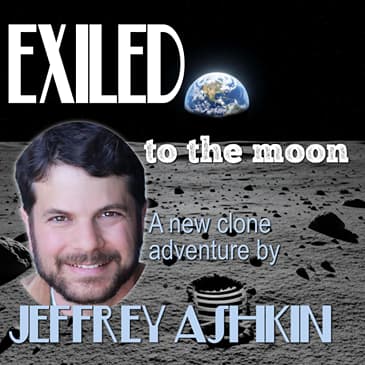


The idea of cloning humans, still a scientific fantasy, makes for intriguing stories that lead us to examine ourselves. How would you feel if you woke up one day as a clone, then discovered your real self was a bad person? Or, you discover your real self is dead, and you’ve been cloned, but at a massive cost that you will never be able to repay?
Author Jeffrey Ashkin’s adventures in cloning take a darker turn in his new novel, The Second World of Sendel, a follow-up to his first novel, The Second Life of Jonathan Sendel. In each story, the protagonist is a clone of a man who died. The clone discovers his creation comes with major strings attached. In the new book, Steven Sendel learns that becoming a clone cost a fortune he must now repay by being conscripted to a lunar mining colony.
“He’s in debt, so he’s alive. But in debt,” says Jeff. “So, because of that, he wants to figure out who put him in the situation and also how to get out of it and reunite with his loved ones.”
To repay the debt, Sendel must work on the Moon mining Helium-3. More and more debt piles up, into millions of dollars, a burden shared by fellow miners. He decides to try to return to Earth to discover who signed him up for this arrangement, and the adventure ensues.
The author’s fascination with cloning grabs you from the start and propels you through the story. Here’s our conversation.
00:00:03 --> 00:00:07 Welcome to TypeTune Tent. I'm Tom Kranz. Imagine
00:00:07 --> 00:00:11 being shipped off to the moon, 238 miles
00:00:11 --> 00:00:14 from Earth, to be a prisoner in a mining colony.
00:00:14 --> 00:00:17 It's the heavy price paid for virtual immortality
00:00:17 --> 00:00:20 envisioned by author Jeffrey Ashkin in his new
00:00:20 --> 00:00:23 sci -fi novel, The Second World of Sendal. I'm
00:00:23 --> 00:00:25 speaking with Jeff today about a future where
00:00:25 --> 00:00:29 extending your life as a human clone costs millions
00:00:29 --> 00:00:32 of dollars, and the payment plan is impossible.
00:00:32 --> 00:00:35 And I'm joined once again by Jeffrey Ashkin from
00:00:35 --> 00:00:39 his home in Los Angeles, despite the picture
00:00:39 --> 00:00:42 we see behind him there. Do you wish you were
00:00:42 --> 00:00:45 in the Bay Area instead or not really? You know,
00:00:45 --> 00:00:47 I love San Francisco. I think it's a great city.
00:00:49 --> 00:00:52 one of the beautiful pictures that you can get
00:00:52 --> 00:00:54 when you're in San Francisco. There's like no
00:00:54 --> 00:00:56 bad picture of the Golden Gate Bridge almost,
00:00:56 --> 00:00:58 right? Even when it's cloudy, it's still beautiful.
00:00:58 --> 00:01:01 Jeff has just written his second of what apparently
00:01:01 --> 00:01:04 is going to be a series of books. speculative
00:01:04 --> 00:01:07 fiction in the theme of cloning, something that
00:01:07 --> 00:01:10 we talked about two years ago, the first time
00:01:10 --> 00:01:13 I interviewed Jeff on the release of his first
00:01:13 --> 00:01:15 book, which was called The Second Life of Jonathan
00:01:15 --> 00:01:19 Sendell. That book, and I'm going to let you
00:01:19 --> 00:01:21 recap it real quick, but it was an interesting
00:01:21 --> 00:01:25 take on cloning that kind of got you thinking
00:01:25 --> 00:01:28 about, you know, what would be... If that happened
00:01:28 --> 00:01:31 to me and I realized that the guy I'm cloned
00:01:31 --> 00:01:33 from was a real asshole, how would I deal with
00:01:33 --> 00:01:35 that? That's kind of the subtext of that first
00:01:35 --> 00:01:37 book. The second book, which is the reason we're
00:01:37 --> 00:01:40 here today, is kind of a sequel to that, although
00:01:40 --> 00:01:42 I think it stands alone. I don't think you need
00:01:42 --> 00:01:44 to read the first one to enjoy the second one.
00:01:44 --> 00:01:47 The second one is called The Second World of
00:01:47 --> 00:01:50 Sendal, and this picks up on... basically the
00:01:50 --> 00:01:54 son of Jonathan Sendell, correct, who also has
00:01:54 --> 00:01:57 an untimely death and is cloned. And this has
00:01:57 --> 00:02:00 a whole different theme. This kind of reminds
00:02:00 --> 00:02:05 me a little bit of, there's some taste of 1984,
00:02:05 --> 00:02:09 a little bit of like oligarchy. and people controlling
00:02:09 --> 00:02:11 our lives and whatnot. First of all, before we
00:02:11 --> 00:02:14 get into that, a little bit about Jeff's background.
00:02:14 --> 00:02:17 So you're a special ed teacher in the Los Angeles
00:02:17 --> 00:02:19 School District. Tell us a little bit about how
00:02:19 --> 00:02:21 long you've done that and where you do it and
00:02:21 --> 00:02:24 why you do it. Well, thank you. First of all,
00:02:24 --> 00:02:28 thanks for having me. Sure. Well, I got into
00:02:28 --> 00:02:31 teaching, actually, for some stability. The film
00:02:31 --> 00:02:35 industry is not, I would say, a very stable industry.
00:02:36 --> 00:02:38 A lot of people. And you were an aspiring act,
00:02:39 --> 00:02:41 well, were and are. You have done some acting
00:02:41 --> 00:02:44 and you continue to look, bite at opportunities
00:02:44 --> 00:02:47 as they arise. Yes, absolutely. I did some acting,
00:02:47 --> 00:02:50 did some writing, did some production work, worked
00:02:50 --> 00:02:53 on sets. But I really wanted to have some stability.
00:02:53 --> 00:02:56 And as I mentioned, it just wasn't stable for
00:02:56 --> 00:03:00 me. So I found something that also inspired me,
00:03:00 --> 00:03:03 which was teaching. My mom was a special ed teacher
00:03:03 --> 00:03:06 for many years. My brother teaches. And it just
00:03:06 --> 00:03:09 seemed like going to the family business, which
00:03:09 --> 00:03:14 is teaching. And I've really enjoyed being in
00:03:14 --> 00:03:16 the classroom. I've enjoyed the process of working
00:03:16 --> 00:03:20 with students and finding out. what inspires
00:03:20 --> 00:03:22 them. I really enjoy talking about books. One
00:03:22 --> 00:03:24 of the things that I've always talked about,
00:03:24 --> 00:03:26 it's so funny to me. I don't know if I'm repeating
00:03:26 --> 00:03:27 myself. I don't know if I mentioned this before,
00:03:27 --> 00:03:30 but one of my favorite things growing up was
00:03:30 --> 00:03:33 reading a book with a class. And the reason why
00:03:33 --> 00:03:36 I love doing that is because you would have an
00:03:36 --> 00:03:39 experience of someone who didn't want to read
00:03:39 --> 00:03:41 that book, reading that book and having the class
00:03:41 --> 00:03:43 discussions where someone would. say their opinion
00:03:43 --> 00:03:45 on a book they had absolutely no interest in.
00:03:46 --> 00:03:48 It's fascinating to me. And that's one of the
00:03:48 --> 00:03:51 few times that you actually would get someone's
00:03:51 --> 00:03:56 opinion on a story that you would not hear normally.
00:03:56 --> 00:03:59 You know, I've been told like, oh, you know,
00:03:59 --> 00:04:01 you can join a book club. It's like, yeah, but
00:04:01 --> 00:04:02 if you join a book club, you're still getting
00:04:02 --> 00:04:05 people who are interested in reading. I like
00:04:05 --> 00:04:08 when people are in a situation where they have
00:04:08 --> 00:04:10 to read something and then give an opinion on
00:04:10 --> 00:04:11 it. Just to me, that's just very interesting.
00:04:12 --> 00:04:14 Anyway. Have you been able to bring reading into
00:04:14 --> 00:04:17 your classrooms? Yeah, I have. I mean, I've taught
00:04:17 --> 00:04:19 high school right now. I'm teaching elementary
00:04:19 --> 00:04:23 school. So the books, of course, have to be approved
00:04:23 --> 00:04:26 by the district and everything is, of course,
00:04:26 --> 00:04:30 you know, everything has to be appropriate for
00:04:30 --> 00:04:33 the students. So with that in mind, I find that
00:04:33 --> 00:04:37 the students responded to books that I was surprised
00:04:37 --> 00:04:40 about. One example, we did The Curious Incident
00:04:40 --> 00:04:44 of the Dog in the Nighttime. which for those
00:04:44 --> 00:04:49 who are listening don't know, it's about a boy
00:04:49 --> 00:04:51 who's on the spectrum who tries to solve the
00:04:51 --> 00:04:56 mystery of what happened to his dog. So it basically
00:04:56 --> 00:04:59 becomes a detective. And I find my students,
00:05:00 --> 00:05:01 and this all takes place in England, by the way,
00:05:01 --> 00:05:04 I should mention that. And the child on the spectrum
00:05:04 --> 00:05:07 who lives in England trying to solve the mystery
00:05:07 --> 00:05:09 of his dog, all my students loved it. And all
00:05:09 --> 00:05:12 of us come from Los Angeles. Never been to...
00:05:12 --> 00:05:15 These are high school age kids? Yes, yeah. Not
00:05:15 --> 00:05:18 the elementary school, the high school ones,
00:05:18 --> 00:05:19 yeah. But they all really related to it. And
00:05:19 --> 00:05:21 I thought that was interesting. Well, I shouldn't
00:05:21 --> 00:05:22 say related, but they all really enjoyed the
00:05:22 --> 00:05:25 story. They enjoyed the progression of action.
00:05:25 --> 00:05:28 And I really was inspired by that because if,
00:05:28 --> 00:05:30 and this is something that's not a unique quote
00:05:30 --> 00:05:32 to me, but they say, one of the things I've read
00:05:32 --> 00:05:37 in my research of writing and everything in terms
00:05:37 --> 00:05:39 of storytelling is, You want to make something
00:05:39 --> 00:05:43 universal? Make it very specific. The more specific
00:05:43 --> 00:05:45 you make it, the more universal it becomes. It's
00:05:45 --> 00:05:49 kind of a strange way of going about it, but
00:05:49 --> 00:05:52 when I write for my own stories, I try to make
00:05:52 --> 00:05:56 it very specific. I get that, totally. It's the
00:05:56 --> 00:05:58 specific stuff that people as readers can identify
00:05:58 --> 00:06:02 with. That's exactly right. Two years ago, when
00:06:02 --> 00:06:05 I first had Jeff on in 2024, we talked a little
00:06:05 --> 00:06:08 bit about your past as an actor. You've had some
00:06:08 --> 00:06:13 small roles in one of my favorite was. The medical
00:06:13 --> 00:06:15 show, which name escapes me right now, Grey's
00:06:15 --> 00:06:18 Anatomy, right? You had a great, you had a role
00:06:18 --> 00:06:20 there as a patient. Actual, you were in the bed
00:06:20 --> 00:06:22 and then you were walking. And I forget, did
00:06:22 --> 00:06:24 you have a line in that? Did you have any lines?
00:06:24 --> 00:06:27 No. Doesn't matter. But you had like, there you
00:06:27 --> 00:06:29 were on the screen. And then you're also in one
00:06:29 --> 00:06:31 of the very last scenes on the first Iron Man
00:06:31 --> 00:06:34 film. You did a bunch of films when you were
00:06:34 --> 00:06:36 in school, in college, I guess. So the whole
00:06:36 --> 00:06:38 acting thing, that's a bug that's been with you
00:06:38 --> 00:06:41 for a long time. How do you find the time? to
00:06:41 --> 00:06:43 sit down and write a book if you're, you're dealing
00:06:43 --> 00:06:45 with curriculums and I'm sure you have enough
00:06:45 --> 00:06:48 homework as a teacher, you know, planning and
00:06:48 --> 00:06:51 doing stuff at home. Where do you, how do you
00:06:51 --> 00:06:53 do that? How do you budget time to write yet
00:06:53 --> 00:06:56 another book? Well, I find that, uh, I find that
00:06:56 --> 00:06:59 at nighttime when my kids go down, I have a couple
00:06:59 --> 00:07:02 of kids and one on the way. Um, congratulations.
00:07:03 --> 00:07:07 Thank you. Um, I find that, uh, at night usually
00:07:07 --> 00:07:10 is the best time for me. I find that, uh, I am
00:07:10 --> 00:07:14 able to focus on it after my work is done. For
00:07:14 --> 00:07:16 teaching, I try to do all my lesson planning
00:07:16 --> 00:07:20 either right after school ends or right before
00:07:20 --> 00:07:25 the week starts on a Sunday night. And that usually
00:07:25 --> 00:07:27 helps. I would say that one of the things about
00:07:27 --> 00:07:30 me, and I would love to say that I'm one of those
00:07:30 --> 00:07:33 writers who has a structured schedule of I wake
00:07:33 --> 00:07:35 up and I write for three or four hours. Like,
00:07:35 --> 00:07:36 I don't have that. I don't have that. Well, it's
00:07:36 --> 00:07:38 no fun. Who wants to do that? But it's always
00:07:38 --> 00:07:40 funny to me because I always hear about writers
00:07:40 --> 00:07:42 who have like these structures about how they
00:07:42 --> 00:07:44 write and how, you know, and I'm like, you're
00:07:44 --> 00:07:47 just I don't I don't I don't believe you. I don't
00:07:47 --> 00:07:50 I don't think if you have a job or have something
00:07:50 --> 00:07:52 else, I don't think you're able to do this. I
00:07:52 --> 00:07:55 totally agree. Yeah. You know, so my feeling
00:07:55 --> 00:07:58 is I write when I can. And if that means that
00:07:58 --> 00:08:01 I'm sitting around and I'm inspired, I'll just
00:08:01 --> 00:08:04 start jotting notes on my notes app and get something
00:08:04 --> 00:08:08 down on paper or in digital. I find that when
00:08:08 --> 00:08:12 I'm out and about, if I'm driving and I have
00:08:12 --> 00:08:14 an idea, I'm like, well, I got to pull over.
00:08:14 --> 00:08:17 And I just have to start writing. It's just something
00:08:17 --> 00:08:21 that happens. So how long does it take you to
00:08:21 --> 00:08:22 write a book then? Like how long did it take
00:08:22 --> 00:08:25 you to write the second one? Well, it was interesting.
00:08:25 --> 00:08:28 Yeah. The second one took me about a couple of
00:08:28 --> 00:08:32 years. I would say that we started, I'd say we,
00:08:32 --> 00:08:34 I should say, my publisher said I had, well,
00:08:35 --> 00:08:37 after the, First book had come out and the reviews
00:08:37 --> 00:08:40 were good and we were discussing other books
00:08:40 --> 00:08:43 that I could do. She mentioned, do you want to
00:08:43 --> 00:08:45 do something in this world still? And I said,
00:08:45 --> 00:08:47 well, the Jonathan Sendell character I think
00:08:47 --> 00:08:49 has been explored. I really told the story I
00:08:49 --> 00:08:52 wanted to tell with him. But there are things
00:08:52 --> 00:08:56 in this world I'd love to explore. And one of
00:08:56 --> 00:08:59 the things that I wanted to explore was kind
00:08:59 --> 00:09:02 of the flip side of cloning. Like we've talked
00:09:02 --> 00:09:04 about how someone really wealthy would be cloned
00:09:04 --> 00:09:07 because they want to live forever and do what
00:09:07 --> 00:09:09 they want without giving away too much about
00:09:09 --> 00:09:11 the first book. But the second book could be
00:09:11 --> 00:09:14 about, like I said, the flip side of that, which
00:09:14 --> 00:09:17 is some being cloned because they owe money.
00:09:18 --> 00:09:20 I had an experience, I don't want to get into
00:09:20 --> 00:09:22 too much, but I had a medical bill that was not
00:09:22 --> 00:09:25 my responsibility. It was supposed to be taken
00:09:25 --> 00:09:29 care of. And for several years, it was sent to
00:09:29 --> 00:09:31 me like, you got to pay this bill. When are you
00:09:31 --> 00:09:33 paying this bill? That's kind of thing. I'm like,
00:09:33 --> 00:09:37 this is not this is not meant to be paid by me
00:09:37 --> 00:09:38 you know i mean that kind of thing i had one
00:09:38 --> 00:09:41 of those i get that yeah and i think a lot of
00:09:41 --> 00:09:43 us yeah exactly i think a lot of people can relate
00:09:43 --> 00:09:45 to that so i want to take that to the extreme
00:09:45 --> 00:09:50 satirically wise which is someone who who died
00:09:50 --> 00:09:52 and had to be brought back because they owe money
00:09:52 --> 00:09:58 and i honestly feel 100 if this could be a thing
00:09:58 --> 00:10:00 that could actually happen it would be it would
00:10:00 --> 00:10:03 happen i do think that companies If you died
00:10:03 --> 00:10:05 in debt, they would bring you back to pay off
00:10:05 --> 00:10:08 your debt. So tell us real quick. So you're starting
00:10:08 --> 00:10:10 to get into a little bit about the plots here.
00:10:10 --> 00:10:12 Two years ago, we talked about your first novel,
00:10:12 --> 00:10:15 The Second Life of Jonathan Sendell. And give
00:10:15 --> 00:10:19 us just a thumbnail sketch of that book, the
00:10:19 --> 00:10:21 protagonist, and what was the concept there?
00:10:22 --> 00:10:27 So the first book was all about how I felt that
00:10:27 --> 00:10:34 if you could live forever, And well, even definitely,
00:10:34 --> 00:10:36 I think that people who are wealthy would do
00:10:36 --> 00:10:39 it. And the first book was exploring that. So
00:10:39 --> 00:10:43 in the future, if you are murdered, and I think
00:10:43 --> 00:10:45 even we explored about the idea that if you were
00:10:45 --> 00:10:48 killed, like in some accidental way, you could
00:10:48 --> 00:10:51 be brought back, new body, same, same, you know,
00:10:51 --> 00:10:53 facial features, same memories, and you just
00:10:53 --> 00:10:56 pick up and go, you know, continue on from where
00:10:56 --> 00:11:00 you left off. So you are cloned as a carbon copy
00:11:00 --> 00:11:04 of your real self. Exactly. So you'd wake up,
00:11:04 --> 00:11:05 have all the memories, and you'd be like, oh,
00:11:05 --> 00:11:07 let me start off where I left off. Oh, and then
00:11:07 --> 00:11:09 you find out you were murdered or whatever happened
00:11:09 --> 00:11:11 to you, and the police would say, what happened?
00:11:11 --> 00:11:13 And you could find out from your memories what
00:11:13 --> 00:11:17 happened, and you would relay the information,
00:11:17 --> 00:11:19 and they would capture the criminal who did it
00:11:19 --> 00:11:23 immediately. So that's how the book starts. But
00:11:23 --> 00:11:25 our main character in the story, in the first
00:11:25 --> 00:11:28 book, goes through an existential crisis where
00:11:28 --> 00:11:31 he starts to figure out things about his former
00:11:31 --> 00:11:35 life and wonder about the idea that maybe he
00:11:35 --> 00:11:37 doesn't have, just because he has the memories
00:11:37 --> 00:11:40 of the person he was, doesn't mean he is that
00:11:40 --> 00:11:44 person. And it was basically his journey becoming
00:11:44 --> 00:11:46 his own person while also solving the mystery
00:11:46 --> 00:11:50 of who killed the person he's based on. But the
00:11:50 --> 00:11:52 things he finds out about his real self were
00:11:52 --> 00:11:55 not good things, that his real self was kind
00:11:55 --> 00:11:57 of a bad guy. And that was kind of a shock to
00:11:57 --> 00:11:59 him as he went along and trying to figure out
00:11:59 --> 00:12:02 who murdered him. Exactly. It's almost a play
00:12:02 --> 00:12:05 on the nature versus nurture. I wanted to explore
00:12:05 --> 00:12:08 like, well, if he has these memories, is he this
00:12:08 --> 00:12:12 person? Or are you born with this sense of morality?
00:12:12 --> 00:12:15 or or not and that was the thing i really like
00:12:15 --> 00:12:16 to play with and that was what the first book
00:12:16 --> 00:12:18 was all about yeah and we got into a discussion
00:12:18 --> 00:12:21 then about you know our own our own selves and
00:12:21 --> 00:12:24 about you know looking back at maybe some behaviors
00:12:24 --> 00:12:26 that we are not particularly proud of and are
00:12:26 --> 00:12:30 those who we really were or those not who we
00:12:30 --> 00:12:32 really were in that, that folks go two years
00:12:32 --> 00:12:35 ago and look at my, it's on my podcast website.
00:12:35 --> 00:12:37 It's good. It was a good discussion. All right.
00:12:37 --> 00:12:40 So now fast forward two years, it's 2026. And
00:12:40 --> 00:12:44 I forget how many years, uh, elapsed in the storyline,
00:12:44 --> 00:12:47 but now we have the second world. So the first
00:12:47 --> 00:12:50 one was the second life of Jonathan Sendell.
00:12:50 --> 00:12:53 Now we have the second world of Sendell, right?
00:12:53 --> 00:12:56 And now we, we basically have Jonathan's son.
00:12:56 --> 00:13:00 correct? Stephen, and very much like the first
00:13:00 --> 00:13:04 book, this guy wakes up in a lab and he realized
00:13:04 --> 00:13:07 he's a clone of his former self. And without
00:13:07 --> 00:13:09 giving up too much, just tell us what's a little
00:13:09 --> 00:13:11 bit different about this story. Well, in this
00:13:11 --> 00:13:14 story, instead of him trying to figure out a
00:13:14 --> 00:13:17 murder that happened to him, he tried to figure
00:13:17 --> 00:13:21 out how he got in this situation. He was suffering
00:13:21 --> 00:13:27 from cancer and his I don't want to give away
00:13:27 --> 00:13:29 too much, but his sponsor, who will not remain
00:13:29 --> 00:13:33 nameless, signed him up for this program to essentially
00:13:33 --> 00:13:39 save him from death. And because of it, he's
00:13:39 --> 00:13:42 in debt. So he's alive, but in debt. And it's
00:13:42 --> 00:13:44 like those two things are synonymous because
00:13:44 --> 00:13:48 of his situation. So because of that, he wants
00:13:48 --> 00:13:52 to go through a mystery of his own to figure
00:13:52 --> 00:13:56 out who put him in this situation. how to get
00:13:56 --> 00:13:59 out of it and reunite with his loved ones. I
00:13:59 --> 00:14:02 won't say we went more than that, but essentially
00:14:02 --> 00:14:06 we go through a whole adventure to figure out
00:14:06 --> 00:14:10 how to stop this. You could say conspiracy, I
00:14:10 --> 00:14:13 would say of people who get in such situations
00:14:13 --> 00:14:18 like this in the world that in the story. So
00:14:18 --> 00:14:21 he would basically. uh, find clues and go through
00:14:21 --> 00:14:25 the, uh, the, uh, I would say a little espionage
00:14:25 --> 00:14:28 to figure out the, uh, the culprit behind this
00:14:28 --> 00:14:32 fast corporate conspiracy. Yeah. And so the,
00:14:32 --> 00:14:35 you know, the, the looming lurking bad guy in
00:14:35 --> 00:14:39 the, in the novel is this gigantic company. It's,
00:14:39 --> 00:14:42 um, is it drain tech, right? Is the, is the company
00:14:42 --> 00:14:44 that you named after some guy named drain and
00:14:44 --> 00:14:47 there's this all seeing bad guy and there's this
00:14:47 --> 00:14:49 big company. And, you know, the idea is that
00:14:49 --> 00:14:53 these clones are kind of, I don't want to give
00:14:53 --> 00:14:55 away too much, but I think what was the intriguing
00:14:55 --> 00:14:58 part was that the clones are, to pay this debt
00:14:58 --> 00:15:01 back, they are basically conscripted to become
00:15:01 --> 00:15:05 miners on the frickin' moon, right? So he gets
00:15:05 --> 00:15:07 shipped to the moon and there's this whole...
00:15:07 --> 00:15:10 this whole subplot of what goes on and who these
00:15:10 --> 00:15:12 miners are and living on the moon. And I kind
00:15:12 --> 00:15:14 of love that part because my second sci -fi novel
00:15:14 --> 00:15:17 is all about the moon. And I had to do a lot
00:15:17 --> 00:15:19 of research on how you live on the moon. And
00:15:19 --> 00:15:22 why did you pick helium three? Because helium
00:15:22 --> 00:15:24 three actually exists under the surface. And
00:15:24 --> 00:15:27 there's all this, you know, how do we walk on
00:15:27 --> 00:15:29 them? And I just kind of like that. There's,
00:15:29 --> 00:15:32 there's a lot of kind of sci -fi stuff about
00:15:32 --> 00:15:35 life on the moon and how that would work. And
00:15:35 --> 00:15:37 then he has to come back to Earth. He goes to
00:15:37 --> 00:15:38 the moon, he comes back to Earth, and he meets
00:15:38 --> 00:15:42 people. And the whole search for the person who
00:15:42 --> 00:15:47 actually signed the papers to get him into this
00:15:47 --> 00:15:52 deal that seemed to have no exit is his kind
00:15:52 --> 00:15:54 of obsession for the second half of the book.
00:15:54 --> 00:15:57 So of all the things that you can write about,
00:15:57 --> 00:16:00 cloning is obviously an interest of yours. Why
00:16:00 --> 00:16:04 that as opposed to... I don't know, spaceships
00:16:04 --> 00:16:07 and ray guns and let's all go to Mars. Well,
00:16:07 --> 00:16:09 I just feel like cloning is a very interesting
00:16:09 --> 00:16:11 subject in terms of our own female psychology.
00:16:11 --> 00:16:13 One of the things that I've noticed from being
00:16:13 --> 00:16:16 a father is, and it's funny because I love my
00:16:16 --> 00:16:18 kids very much, but I've noticed something about,
00:16:19 --> 00:16:22 now I'm going to say something. I've noticed
00:16:22 --> 00:16:24 we're not born with inherent logic, reasoning,
00:16:24 --> 00:16:27 morality, empathy. We're not. We're just not.
00:16:28 --> 00:16:31 You are born with. you know, learning about how
00:16:31 --> 00:16:33 things work and your own self, that you're not
00:16:33 --> 00:16:38 born knowing a sense of logic and reasoning and
00:16:38 --> 00:16:40 morality. No, you're born with little more than
00:16:40 --> 00:16:43 animal instincts, basically. Exactly. Yeah. I
00:16:43 --> 00:16:47 find that fascinating. I mean, it's so obvious,
00:16:47 --> 00:16:49 but it's something I never really realized until
00:16:49 --> 00:16:52 I became a father myself, that, you know, you
00:16:52 --> 00:16:55 have to put that in someone, or I mean, eventually
00:16:55 --> 00:16:57 a father anyway, from a teacher or from some
00:16:57 --> 00:17:00 sort of other. you know adult figure authority
00:17:00 --> 00:17:04 they will learn that eventually but what if you
00:17:04 --> 00:17:09 are cloned you have memories of someone for whatever
00:17:09 --> 00:17:12 and how do you react to that now it's even the
00:17:12 --> 00:17:15 main character in this novel steven he doesn't
00:17:15 --> 00:17:18 have the the baggage i would say that his father
00:17:18 --> 00:17:24 does but he does have memories that he does have
00:17:24 --> 00:17:26 to reconcile as well in the course of the story
00:17:26 --> 00:17:29 memories about his his loved ones, I want to
00:17:29 --> 00:17:31 get into it, but also people in his life that
00:17:31 --> 00:17:34 he feels a certain way about and he realizes
00:17:34 --> 00:17:38 that that's not the case. I think that one of
00:17:38 --> 00:17:40 the things that we do collectively as people
00:17:40 --> 00:17:43 is we hold up our memories in such high regard
00:17:43 --> 00:17:47 in terms of the good ones, the bad ones, but
00:17:47 --> 00:17:49 I feel like memories are changing all the time
00:17:49 --> 00:17:51 too. In the sense that you have the same memory,
00:17:51 --> 00:17:54 but from a medical standpoint, you're actually
00:17:54 --> 00:17:56 remembering the last time you remembered it.
00:17:56 --> 00:17:59 It's weird. you know, your muscles and your cells
00:17:59 --> 00:18:02 are always growing and moving. So it's not like
00:18:02 --> 00:18:04 you have the same exact memory. You actually
00:18:04 --> 00:18:06 might remember it. And then there might be something
00:18:06 --> 00:18:07 slightly different this time, slightly different
00:18:07 --> 00:18:10 this time. and it's not always gonna be the same
00:18:10 --> 00:18:13 memory because you're maturing now as a 71 year
00:18:13 --> 00:18:15 old dude whose memory is like not what it used
00:18:15 --> 00:18:18 to be 30 years ago i just wrote a series of of
00:18:18 --> 00:18:20 true stories about my life in broadcasting and
00:18:20 --> 00:18:25 that required me going back 30 35 years to tell
00:18:25 --> 00:18:28 some stories about my initial days in radio and
00:18:28 --> 00:18:30 my college days and blah blah blah in the process
00:18:30 --> 00:18:33 i talked to some of my colleagues who are mentioned
00:18:33 --> 00:18:37 in the book and i see that That memory is not
00:18:37 --> 00:18:41 exactly the way he remembers it. Or maybe it's
00:18:41 --> 00:18:44 not really the real memory. Maybe my brain fucked
00:18:44 --> 00:18:47 it up somehow or changed it in the telling of
00:18:47 --> 00:18:50 it. So that's actually really interesting. Yeah,
00:18:50 --> 00:18:52 exactly. That's the way I feel too. Because I
00:18:52 --> 00:18:56 have an older brother. We have a lot of the same
00:18:56 --> 00:18:58 shared experiences growing up. But he remembers
00:18:58 --> 00:19:00 things differently. He remembers things happening
00:19:00 --> 00:19:02 a certain way. I remember, are you sure? And
00:19:02 --> 00:19:04 then, of course, we look up. like the day or
00:19:04 --> 00:19:06 something you can do that now obviously thanks
00:19:06 --> 00:19:08 to the internet you can look up what day certain
00:19:08 --> 00:19:11 things happen but even so even if we can get
00:19:11 --> 00:19:13 the correct date on it we still remember it differently
00:19:13 --> 00:19:17 so it just i think that's fascinating so in the
00:19:17 --> 00:19:20 story he goes through a a similar but different
00:19:20 --> 00:19:22 journey than his father did to reconcile those
00:19:22 --> 00:19:25 memories as also and as you mentioned also getting
00:19:25 --> 00:19:28 off the moon getting back to earth solving this
00:19:28 --> 00:19:31 vast conspiracy and you know hopefully saving
00:19:31 --> 00:19:36 the day at the end How did you research cloning
00:19:36 --> 00:19:40 life on the moon space travel? Did you just go
00:19:40 --> 00:19:42 through, you know, go on to Google or do you
00:19:42 --> 00:19:45 have any actual, you know, sources who are like,
00:19:45 --> 00:19:47 you know, brilliant people or how'd you figure
00:19:47 --> 00:19:51 that out? Oh, thank you for asking that. Are
00:19:51 --> 00:19:54 you sorry I asked that? No, it's funny because
00:19:54 --> 00:19:57 I didn't, you know, that's a good point. I mean,
00:19:57 --> 00:19:59 I did look it up. Actually, I did a Google search
00:19:59 --> 00:20:02 on what type of materials would be found in the
00:20:02 --> 00:20:04 moon. Well, totally. And I saw that and I said,
00:20:04 --> 00:20:06 wow, he got that whole helium thing. That's what
00:20:06 --> 00:20:09 I came upon the same thing. No, but I've always
00:20:09 --> 00:20:12 been fascinated. I mean, as a fan of science
00:20:12 --> 00:20:15 and a fan of space exploration, I've always been
00:20:15 --> 00:20:18 fascinated by. The idea that we are going to
00:20:18 --> 00:20:21 become an interplanetary species very soon. We
00:20:21 --> 00:20:23 are going to have people back on the moon. We
00:20:23 --> 00:20:26 are going to have people on Mars. It is, I don't
00:20:26 --> 00:20:30 know, the long -term, you know, effects or the
00:20:30 --> 00:20:35 long -term possibilities of it. But I do think
00:20:35 --> 00:20:37 we're going to eventually have, in our lifetimes,
00:20:37 --> 00:20:39 I would say, and you as well, we're going to
00:20:39 --> 00:20:42 have them, I'd say in the next 20 years, for
00:20:42 --> 00:20:44 sure, we're going to have people on the moon,
00:20:44 --> 00:20:47 people on Mars, for sure. I mean, I don't know.
00:20:47 --> 00:20:50 In 20 years, I'm going to look back at this podcast
00:20:50 --> 00:20:52 and find out if I'm correct. But the point is,
00:20:52 --> 00:20:55 I looked up all that information online, went
00:20:55 --> 00:20:58 to NASA, I did a Google search, and I was just
00:20:58 --> 00:21:02 fascinated by what's going on in our exploration.
00:21:02 --> 00:21:04 We want to have a moon base. We want to have
00:21:04 --> 00:21:07 a presence on the moon, which makes sense in
00:21:07 --> 00:21:08 terms of long -term exploration for the other
00:21:08 --> 00:21:13 planets. So if there was to be a moon base set
00:21:13 --> 00:21:16 up, there'd probably be... infrastructure set
00:21:16 --> 00:21:18 up there that would need to have a lot of supplies
00:21:18 --> 00:21:22 so you would want to have a collection of people
00:21:22 --> 00:21:26 there it would be interesting from a uh from
00:21:26 --> 00:21:28 the from the point of view of the novel if they're
00:21:28 --> 00:21:31 going to have people who are conscripted to be
00:21:31 --> 00:21:33 here they probably would want them on the moon
00:21:33 --> 00:21:37 so they wouldn't be a distraction on earth and
00:21:37 --> 00:21:41 that was my kind of uh that was my purpose in
00:21:41 --> 00:21:43 putting them there because it is controversial
00:21:43 --> 00:21:47 so having them put there would not have the distractions
00:21:47 --> 00:21:49 on earth and people trying to find out what happened
00:21:49 --> 00:21:51 to their loved ones it would be difficult it
00:21:51 --> 00:21:53 takes three days to get to the moon so just that
00:21:53 --> 00:21:56 little bit of and i do think it would take a
00:21:56 --> 00:21:58 while for them to be discovered and i do think
00:21:58 --> 00:22:01 that there will be like there are pleasure cruises
00:22:01 --> 00:22:03 in the ocean there will be one going to the moon
00:22:03 --> 00:22:08 i bet i bet cash money that will happen and yeah
00:22:08 --> 00:22:11 sure and it's happening already people do go
00:22:11 --> 00:22:12 into space if you're really wealthy you throw
00:22:12 --> 00:22:15 space tourism now so I know. We're on the brink
00:22:15 --> 00:22:16 of that right now. I think that's probably the
00:22:16 --> 00:22:19 next generation is actually going to see the
00:22:19 --> 00:22:23 reality of actually guys living on the moon and
00:22:23 --> 00:22:25 landing on Mars. When you write science fiction,
00:22:25 --> 00:22:28 even a little science fiction, the science has
00:22:28 --> 00:22:31 to kind of be right. Because the geeks out there
00:22:31 --> 00:22:33 will call you on it. And making the science right
00:22:33 --> 00:22:36 actually adds to the story in me. People can
00:22:36 --> 00:22:39 tell right away when you're making up bullshit.
00:22:39 --> 00:22:42 But if it sounds like you know what you're talking
00:22:42 --> 00:22:45 about because you actually do, I think it makes
00:22:45 --> 00:22:47 a difference in the reader's enjoyment of the
00:22:47 --> 00:22:49 book. That's what I found anyway. And I certainly
00:22:49 --> 00:22:52 found that in your books, especially the second
00:22:52 --> 00:22:54 one. I appreciate that. Thank you. I really tried
00:22:54 --> 00:22:58 to keep the science to have some... uh realism
00:22:58 --> 00:23:03 to it and some speculative uh uh rationale and
00:23:03 --> 00:23:06 reasoning to it as well as obviously we don't
00:23:06 --> 00:23:08 have the technology right now but i feel like
00:23:08 --> 00:23:12 this would be very close to what could be uh
00:23:12 --> 00:23:15 implemented very soon It is science, but it's
00:23:15 --> 00:23:17 also fiction. So let's not let our imaginations
00:23:17 --> 00:23:22 go to sleep. But I do think that, as I said,
00:23:22 --> 00:23:25 the real science does help elevate the story.
00:23:25 --> 00:23:28 So do you have any aspirations of turning these
00:23:28 --> 00:23:32 into screenplays? I would absolutely love it.
00:23:32 --> 00:23:36 I mean, you're doing it yourself. I'm trying
00:23:36 --> 00:23:38 to do that myself now, which means learning that
00:23:38 --> 00:23:41 whole screenplay. freaking you know the formatting
00:23:41 --> 00:23:43 and i went and bought the software and it's like
00:23:43 --> 00:23:45 i don't know that anything's ever going to come
00:23:45 --> 00:23:47 from it but i want to be able to say i tried
00:23:47 --> 00:23:50 you know i i would love it i if my books got
00:23:50 --> 00:23:52 so popular that they wanted to turn them to movies
00:23:52 --> 00:23:54 i would love that um but yeah but you're not
00:23:54 --> 00:23:55 going to wait for that right fuck if they're
00:23:55 --> 00:23:59 popular or not you can do it bro no i know i
00:23:59 --> 00:24:02 know no i i right now i've been just focusing
00:24:02 --> 00:24:05 on just telling the books right now one of the
00:24:05 --> 00:24:07 things about writing a novel is the complete
00:24:07 --> 00:24:09 creative control that I've had. My publisher
00:24:09 --> 00:24:12 just fixes the grammar. She's very supportive
00:24:12 --> 00:24:15 of, shout out to Corinne Anderson at Inksmith
00:24:15 --> 00:24:18 Publishing. I have to mention her. She's really
00:24:18 --> 00:24:20 supportive of whatever journey I want to go on.
00:24:20 --> 00:24:24 As someone who's tried to put screenplays out
00:24:24 --> 00:24:26 into the world and make them into movies, it
00:24:26 --> 00:24:27 is difficult, especially when you have producers
00:24:27 --> 00:24:30 and they have notes. And I understand that. Sometimes
00:24:30 --> 00:24:31 you have them on the same page. Sometimes you
00:24:31 --> 00:24:36 don't. So you have to adjust to what can be done.
00:24:37 --> 00:24:40 Um, but I will say though, yes, uh, I would love
00:24:40 --> 00:24:42 to put them into movies. I'd love to put them
00:24:42 --> 00:24:44 into TV shows. I would say that right now, just,
00:24:45 --> 00:24:47 I really enjoying the books, but if tomorrow
00:24:47 --> 00:24:48 they call, if someone called me and said, Hey,
00:24:48 --> 00:24:50 you want to make it into a movie? I'd be like,
00:24:50 --> 00:24:52 okay. Yeah. I would feel the same way. I don't
00:24:52 --> 00:24:54 think it's going to happen for me, but that's
00:24:54 --> 00:24:58 okay. Um, and finally, so, um, you're planning
00:24:58 --> 00:25:00 on another, another installment here. Are you
00:25:00 --> 00:25:02 planning on a third book or are you going to
00:25:02 --> 00:25:03 write something else or what? What's on your
00:25:03 --> 00:25:07 mind? I do have an idea that I've been exploring
00:25:07 --> 00:25:11 right now. I've outlined and explored the characters
00:25:11 --> 00:25:13 that I want to do for a third book in the series.
00:25:13 --> 00:25:15 Whether I want to go beyond that, I don't know.
00:25:15 --> 00:25:19 But this one I felt like it's more science fiction
00:25:19 --> 00:25:23 space than this one. This one I would say is,
00:25:23 --> 00:25:26 if the first book was a sci -fi murder mystery,
00:25:26 --> 00:25:28 second book I'd say was a sci -fi adventure.
00:25:29 --> 00:25:34 This one I'd say is a science fiction space movie
00:25:34 --> 00:25:40 i put that way um exploring basically uh the
00:25:40 --> 00:25:43 next step of cloning and essentially without
00:25:43 --> 00:25:47 giving too much away where we could go with the
00:25:47 --> 00:25:52 idea of cloning if we wanted to uh i don't get
00:25:52 --> 00:25:54 too much away there but basically where we can
00:25:54 --> 00:25:57 go with cloning if we really wanted to make a
00:25:57 --> 00:26:00 utopia i got you have you started writing that
00:26:00 --> 00:26:04 yet I have, yes. I have. It has been a lot of
00:26:04 --> 00:26:08 fun. And I'm really continuing the Sendhil's
00:26:08 --> 00:26:11 bloodline here, but a new character that will
00:26:11 --> 00:26:14 be related to the previous ones in a way that
00:26:14 --> 00:26:16 I don't want to give away. But it would definitely
00:26:16 --> 00:26:19 be something that I think would take, once again,
00:26:20 --> 00:26:25 a new step in the cloning narrative that I haven't
00:26:25 --> 00:26:27 explored before. Good. Well, I'll look forward
00:26:27 --> 00:26:30 to seeing that. Folks, heartily, highly recommend
00:26:30 --> 00:26:34 Jeffrey Ashkin's first two books. The first one,
00:26:34 --> 00:26:37 The Second Life of Jonathan Sendel, which he
00:26:37 --> 00:26:39 wrote a couple of years ago. And then the book
00:26:39 --> 00:26:43 that just came out, The Second World of Sendel.
00:26:43 --> 00:26:45 As I said earlier, you can read them separately.
00:26:45 --> 00:26:47 You can certainly read the second one without
00:26:47 --> 00:26:49 having read the first, but why not read the first
00:26:49 --> 00:26:51 one too, right? It's not like it's, you know.
00:26:51 --> 00:26:53 What else do you have to do, right, than read
00:26:53 --> 00:26:55 books? Please read books. Anyway, we'll look
00:26:55 --> 00:26:58 forward to the third one in the series. I wish
00:26:58 --> 00:27:01 you all the best with your new classroom of very
00:27:01 --> 00:27:05 young kids in the special ed world of the Los
00:27:05 --> 00:27:07 Angeles public school system. And Jeff Ashkin,
00:27:07 --> 00:27:10 thanks for being with me and lots of success
00:27:10 --> 00:27:12 to you. Thank you. Thank you so much.